Reduce-Only Orders: A Simple Feature That Minimizes Trading Mistakes
In trading, mistakes rarely come from a lack of strategy. More often, they come from execution — especially when multiple orders are active at the same time.
You close a position, the market moves quickly, another order triggers… and suddenly you’ve opened a new position you never intended to take.
This is exactly the kind of scenario the reduce-only parameter is designed to eliminate.

Control every order with reduce-only
What reduce-only actually does
A reduce-only order is built around a very simple rule: it can only reduce your current position. It will never increase it, and it will never open a new one.
That might sound like a small detail, but in practice it changes how safely you can manage trades — particularly in futures and margin markets, where positions can shift quickly and multiple orders often work in parallel.
Instead of constantly double-checking whether your orders might conflict with each other, reduce-only ensures that every execution moves your exposure in one direction only: down.
Why this matters in real trading conditions
The importance of reduce-only becomes clear the moment you start placing several exit orders at different price levels.
Without protection, those orders don’t “know” what happened before them. If one closes your position earlier than expected, the others may still execute — and unintentionally open a new position in the opposite direction.
With reduce-only enabled, the system prevents that entirely. Each order is validated against your actual position at the moment it executes. If there’s nothing left to close, it simply won’t open anything new.
This turns reduce-only into a quiet but powerful risk management layer. It doesn’t change your strategy — it protects it from execution errors.
Where reduce-only is available
On WhiteBIT, the reduce-only parameter is available in futures and margin markets, where precise position control is essential.
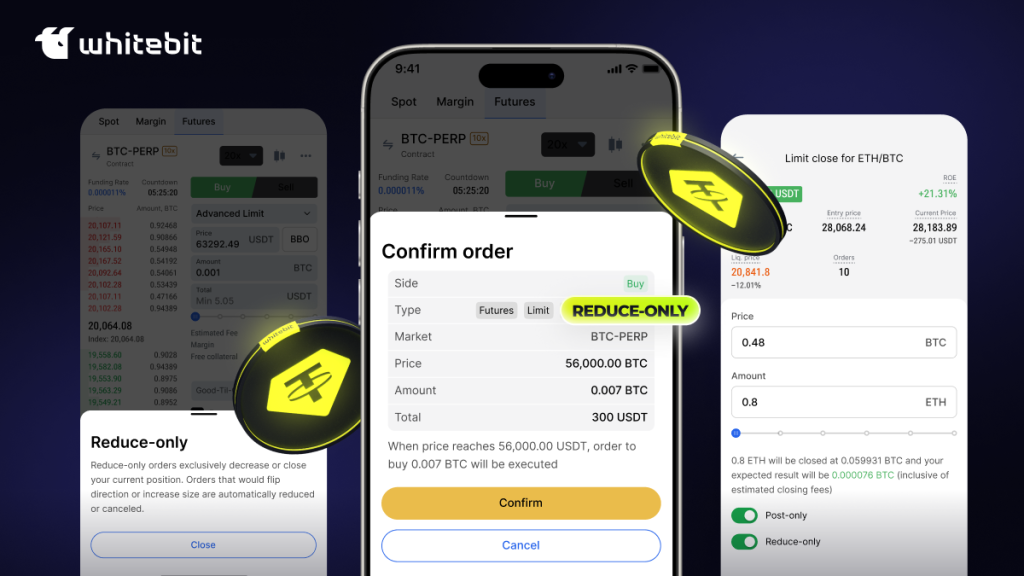
In the interface, it appears as an optional setting within advanced order types, giving you flexibility over how your orders behave.
UI — checkbox available for Advanced order types only (not available for Basic orders)
API — supported for all order types
In certain scenarios, reduce-only is applied automatically. When you close a position using Market Close or Close All Positions, the system ensures the order can only reduce your exposure, removing any risk of opening a new position unintentionally.
For Limit Close orders, the setting remains optional — you can enable or disable reduce-only manually, depending on your strategy.
You can learn more in the Help Center article.
How it behaves under the hood
One of the key mechanics behind reduce-only is something traders often don’t notice at first: automatic adjustment of order size.
If your order is larger than your current position, the system doesn’t reject it outright. Instead, it trims the order down to match what you actually hold.
Imagine holding a 1 BTC long position and sending a reduce-only sell order for 1.6 BTC. The platform will simply adjust that order to 1 BTC and execute it at market conditions, fully closing your position without exceeding it.
The same logic applies even if you edit an order after placing it. If you increase its size beyond your position, it will be automatically reduced again. At no point can a reduce-only order overshoot your exposure.
What happens when multiple orders are active
Reduce-only becomes even more valuable when you’re scaling out of positions.
You might place several orders across different price levels, planning to close parts of your position gradually. The system doesn’t lock these orders to your position size at the moment they are created. Instead, it evaluates them dynamically.
If one order executes and reduces your position, the next one adjusts accordingly. If your position is already fully closed, any remaining reduce-only orders are canceled automatically.
This ensures consistency: no matter how many orders you place, you will never accidentally reverse your position.
Because reduce-only is strictly tied to an existing position, it won’t function in situations where that condition isn’t met.
If there is no open position, there is nothing to reduce — so the order is rejected. The same happens if the order direction matches your current position, since executing it would increase exposure rather than decrease it.
These constraints are intentional. They are what make the feature reliable.
A feature that changes execution quality
Reduce-only doesn’t make your strategy smarter. It makes your execution safer.
It removes a specific class of mistakes — the kind that happen not because the idea was wrong, but because the market moved faster than expected or orders interacted in ways you didn’t anticipate.
In fast-moving markets, that distinction matters.
And sometimes, the difference between a controlled exit and an unintended position isn’t a better strategy — it’s a single parameter that makes sure your orders behave exactly as you intended.
Control every order with reduce-only