What Is a Bubble in Cryptocurrency?

Each new growth cycle in the cryptocurrency market is typically accompanied by a wave of heightened attention, bold forecasts, and expectations of rapid profits. In these phases, digital assets appear especially compelling, drawing in both new and experienced participants. However, it is precisely during such moments of optimism that market distortions begin to form and warrant a more disciplined, sober analysis. One of the most telling manifestations of these conditions is the emergence of a crypto bubble—a phenomenon we will examine in detail below.
What Is Crypto Bubble?
A crypto bubble refers to a market condition in which the valuation of cryptocurrencies, or specific digital assets, becomes materially disconnected from their intrinsic value, practical utility, and underlying fundamentals. In these phases, price appreciation is driven predominantly by speculative demand, short-term profit expectations, and a rapid influx of new market participants, rather than by sustainable technological progress or the long-term economic viability of the project.

Сheck cryptocurrency rates in real-time
Why Crypto Bubbles Form: Key Drivers
The formation of a crypto bubble is a multi-stage process driven by shifts in market behavior rather than a single abrupt event:
- Emergence of a dominant narrative. A crypto bubble typically begins with a powerful narrative—whether a perceived technological breakthrough, growing institutional interest, regulatory optimism, or the early phase of a broader market cycle. At this stage, price appreciation may be partially justified. However, the market starts to price in overly optimistic assumptions well ahead of actual progress, accelerating the upward momentum.
- Mass participation and FOMO. As the trend gains traction, a broad audience enters the market. Demand is increasingly fueled not by a clear understanding of the asset’s value, but by fear of missing out on further gains. The information environment becomes skewed toward bullish signals, and investment decisions are driven more by price action than by fundamental or risk analysis.
- Detachment from fundamentals. At the next stage, asset prices begin to significantly outpace their underlying utility, economic model, and real adoption. Risk perception deteriorates, valuations become stretched, and continued growth is justified almost exclusively by expectations of further upside. The market enters a state of structural overheating.
- Leverage-driven amplification. Momentum is increasingly supported by borrowed capital. The use of leverage, margin trading, and derivatives expands, accelerating price movements while simultaneously increasing systemic fragility. Liquidity becomes unstable, and adverse price moves are amplified through forced liquidations and cascading reactions.
- Loss of stability and reversal. In the final phase, the market loses its capacity to advance even in the presence of positive news. Demand weakens, large participants begin to scale out of positions, and even minor negative triggers can initiate a sharp reversal. The bubble starts to deflate, gradually pulling prices back toward levels that reflect genuine demand and fundamental value.
How to Spot a Bubble Cryptocurrency?
A cryptocurrency bubble rarely emerges abruptly; it is typically preceded by a series of distinct signals that reflect market overheating and shifts in participant behavior. In practice, a crypto bubble can be identified by the following signs:
- Accelerating and unstable price growth. Price movements become sharp and almost vertical, with corrections being brief and shallow. The pace of price increase surpasses the changes in fundamental factors, indicating an overheated demand driven by speculation rather than sustainable growth.
- Shift in participant motivation. Purchases are driven more by a fear of missing out (FOMO) than by a rational understanding of the asset’s value. Emotions start to take precedence over analysis, and discussions around risks fade into the background as excitement dominates the market narrative.
- Surge in speculative activity and leverage. The volume of margin trading and derivatives increases, making the market more reliant on borrowed liquidity. This amplifies price movements and introduces fragility, as the market becomes more sensitive to price deviations and leveraged positions.
- Detachment from fundamental indicators. Asset prices begin to diverge significantly from their real utility, infrastructure development, and actual demand. Valuations grow increasingly difficult to justify, often becoming inflated and disconnected from the underlying market conditions.
- Weakening response to positive news. Even strong news events fail to sustain growth, with prices becoming “stuck” near their highs. This indicates that demand is nearing its peak and signals the onset of a distribution phase, where large participants start to offload assets.
- Increased vulnerability to external triggers. Moderately negative news or a lack of new market drivers is enough to trigger a reversal. The market loses stability, and the imbalances created during the bubble quickly become apparent, accelerating the deflation of the bubble.

Bubble Crypto vs. Real Growth
The key distinction between a crypto bubble and sustainable growth lies not in the speed of price movements but in the underlying quality of demand and the sources driving that growth.
- A crypto bubble forms when price escalation outpaces the actual development of the market. Demand is primarily driven by speculation, with participants focused on short-term profits and fueled by the expectation of further price increases. Leverage becomes more widely used, asset valuations become increasingly inflated, and the market loses its ability to absorb external shocks. In this environment, growth is largely unsustainable, and any deviation from expected price trajectories can trigger sharp corrections.
- In contrast, real growth is grounded in the expansion of use cases, infrastructure development, and the steady inflow of long-term capital. Price movements tend to be more gradual, marked by corrections and periods of consolidation. Interest in the asset persists even during low volatility, indicating deeper market conviction. Such a market is more resilient to external news and does not rely on a continuous influx of new participants to maintain momentum.
The primary practical guideline is to assess what underpins the growth. If price movements are driven by an ever-growing amount of speculative liquidity and emotional demand, the risk of a bubble rises. However, if growth is accompanied by structural advancements and continues without the need for constant hype, it signals a more stable and sustainable market phase.
Key Historical Cryptocurrency Bubbles
Examples of cryptocurrency bubbles illustrate how market overheating forms and how it typically ends. Below are the key and most illustrative cases.
Bitcoin and the 2017 ICO Boom
In 2017, Bitcoin’s price surged from around $1,000 to nearly $20,000, representing a +1,900% increase within a year. This was accompanied by an unprecedented boom in Initial Coin Offerings (ICOs), during which projects raised approximately $5-6 billion, often without a finished product or a functional economy. According to various estimates, more than half of ICO projects later lost liquidity or ceased to exist. Following the peak, the market entered a significant correction, with Bitcoin’s price dropping over 80% by the end of 2018, starkly highlighting the disconnect between market expectations and the actual stability of the market.

DeFi Bubble and Farming (2020)
The explosive growth of DeFi in 2020 was marked by extreme returns: at its peak, annual percentage yields (APY) in yield farming protocols reached hundreds, and even thousands, of percent, while total value locked (TVL) soared from under $1 billion to around $15 billion in just a few months. Capital rapidly moved between protocols searching for the highest returns, and token issuance often served as the main driver of demand. However, as APYs began to decline, the first hacks occurred, and liquidity issues emerged, the market cooled sharply. This revealed the unsustainability of valuations primarily driven by subsidized yields.
The 2021 NFT Bubble
In 2021, NFTs became a focal point for massive speculation, with monthly trading volumes peaking at over $12 billion. The floor prices of popular collections skyrocketed in a short time, despite a lack of corresponding growth in real-world usage. A large portion of the demand was driven by resale potential rather than cultural or utilitarian value. As liquidity and interest waned, the market contracted sharply, with trading volumes falling by more than 90% in 2022–2023. This dramatic decline clearly highlighted the gap between speculative valuations and sustainable demand.
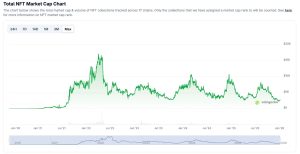
Total market cap & volume of NFT collections tracked across 17 chains. Source: https://www.coingecko.com/

Metaverse and GameFi Tokens (2021)
Metaverse and GameFi tokens saw rapid growth in 2021, fueled by expectations of mass adoption of Web3 games and virtual worlds. The market capitalization of individual projects reached tens of billions of dollars in just a few months, despite a limited number of active users. In many cases, daily user numbers were in the thousands, while estimates suggested millions. Following a shift in market sentiment and a decline in investor interest, most of these tokens corrected by 70-90%, clearly highlighting the gap between speculative expectations and the actual user economy.
Speculative Overheating of the Memecoin Segment
Memecoins evolved from a local novelty to a segment that generated massive market peaks. For instance, Dogecoin reached a market capitalization of over $88 billion, while Shiba Inu hit approximately $43 billion at the height of its growth, placing them among the largest cryptocurrencies by market cap. Similarly, Pepe’s market cap exceeded $11 billion at its peak, despite lacking any fundamental application.
However, these surges were often followed by sharp declines. By 2025, the memecoin segment as a whole showed weak performance—Dogecoin fell by around 62% from its opening price to the end of the year, while Shiba Inu and Pepe both lost more than 65% of their value during the same period.
List of cryptocurrencies by market capitalization
Conclusion
Understanding the phenomenon of crypto bubbles is important not for finding entry or exit points, but for understanding the nature of the market. It is through such phases that the crypto industry is moving from euphoria to maturity, gradually building a more sustainable economy.