Where Ukrainians Are Investing in 2026

Nearly one in two Ukrainian investors considers crypto assets a potential investment option — more than those considering investments in their own businesses and roughly the same proportion as those considering residential real estate. A new study of Ukrainians’ investment habits explores how their financial behavior has evolved, which instruments they use to preserve their savings, and the role crypto assets play in their investment strategies.
Despite economic uncertainty, more Ukrainians are building up their savings while becoming increasingly cautious about their investment choices. Rising spending on essentials, including food and household products, alongside broader economic uncertainty, continues to shape their financial decisions.
So where are Ukrainians putting their money today? Cash, bank accounts, and deposits remain the foundation of their financial strategies. At the same time, a growing range of alternative instruments serves different purposes, from generating passive income to offering the potential for capital appreciation. Cryptocurrency has also found its place in investment portfolios.
To examine how Ukrainians’ investment habits have evolved, WhiteBIT cryptocurrency exchange has conducted its study of Ukrainians’ financial behavior and investment priorities for the third consecutive year. For the past two years, international research company Ipsos has served as the independent research partner.
Saving Despite Growing Pressure on Household Budgets
Financial activity among Ukrainians remains stable in 2026. Some 66% of respondents have a source of income and hold savings or investments, unchanged from the previous year. Meanwhile, the proportion of those setting aside an average of at least UAH 3,000 per month has increased from 30% in 2025 to 35% in 2026.
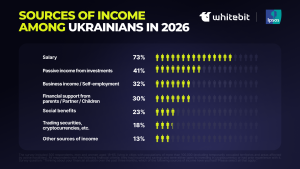
The composition of income has also shifted, albeit modestly. The share of respondents citing salaries as a source of income declined from 79% to 73%, while the proportion receiving passive income from investments rose from 37% to 41%. Income from commercial activities and privately owned businesses also became more common, reported by 32% of respondents in 2026 compared with 27% a year earlier.
At the same time, essential expenses are taking up a growing share of household budgets. In 2026, food and household goods are the main spending category for 78% of respondents, up from 70% the previous year.
In other words, Ukrainians continue to save and invest despite facing higher costs for everyday necessities. Even modest increases in investment and entrepreneurial income suggest that their financial models are gradually becoming more diversified, both in terms of income sources and how they manage their savings.
Beyond a Single Instrument: Building a Mix of Assets
The study reveals that Ukrainians assign different roles to different financial instruments. Increasingly, they view their money not simply as savings but as a mix of assets serving distinct financial purposes.
When it comes to generating passive income, Ukrainians most commonly associate this goal with bank deposits, residential real estate, government securities, commercial real estate, and securities issued by private companies. To mitigate inflation risks, they primarily look to foreign currency cash holdings, foreign currency bank accounts, and residential property. For protecting savings during wartime, respondents associate this function with cash, crypto assets, and bank accounts.
The potential for substantial capital appreciation, meanwhile, is associated with a different set of investment instruments, most notably crypto assets, as well as privately owned businesses and venture capital.
This suggests that Ukrainians are no longer simply looking for somewhere to put their money. Instead, they are assessing how different instruments align with specific financial objectives, whether preserving wealth, generating income, or pursuing potential capital growth.
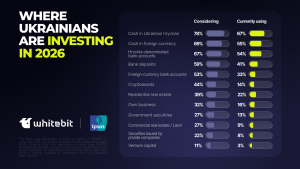
In 2026, cash in Ukrainian hryvnias remains the leading traditional savings instrument, considered by 78% of Ukrainians who have savings, followed by foreign currency cash at 69%. Hryvnia-denominated bank accounts rank next at 67%, followed by bank deposits at 59%. Another 53% consider foreign currency bank accounts.
When it comes to investing and potentially growing capital, 44% consider crypto assets. This exceeds the shares considering investments in their own businesses (32%), government securities (27%), commercial real estate or land (27%), securities issued by private companies (22%), and venture capital (11%).
“We see that Ukrainians are not limiting themselves to a single way of preserving or growing their money. Instead, they are considering different instruments depending on their financial goals. Notably, 44% now consider crypto assets for investment purposes — a higher proportion than those considering their own businesses and roughly on par with residential real estate. This indicates that digital assets have already become a significant part of Ukraine’s investment landscape, even as traditional instruments continue to play a leading role,” WhiteBIT representatives note.
Crypto Assets: A Distinct Place in Investment Strategies
Overall awareness of digital assets among Ukrainians is growing. In 2026, 32% of respondents report being familiar with cryptocurrency, compared with 28% in 2025. The share of those open to using it stands at 19%, up from 17% a year earlier.
Among respondents who already have savings and investments, interest in crypto assets is even stronger: 44% consider them a potential investment instrument, while 14% currently use them. Interest in cryptocurrency as a possible component of an investment strategy therefore remains high, with nearly one in two Ukrainians who have savings considering this asset class.
Actual crypto adoption, however, may be influenced primarily by economic factors. Although the study indicates that absolute income levels have not declined, income gains have been partly offset by currency depreciation and rising essential expenses. Against this backdrop, a relative reduction in funds available for investment may be one factor behind lower actual crypto usage, alongside less favorable cryptocurrency market performance than in previous years — a period commonly referred to as a “crypto winter.”
Nevertheless, cryptocurrency occupies a distinct position in how Ukrainians perceive financial instruments. Rather than viewing it primarily as a substitute for bank deposits or foreign currency cash holdings, they tend to see it as an instrument with investment and capital growth potential.
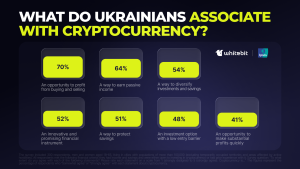
This is also reflected in the associations respondents have with crypto assets. Some 64% associate cryptocurrency with passive income, 54% with diversifying investments or savings, and 52% regard it as an innovative and promising financial instrument. Another 48% describe crypto assets as an investment option requiring relatively little initial capital.
Only 41% of respondents still associate cryptocurrency with the possibility of making substantial profits quickly.
These findings suggest that perceptions of cryptocurrency are gradually moving beyond the prospect of quick financial gains. Alongside potential returns, Ukrainians increasingly associate crypto assets with diversification, passive income, and broader investment opportunities.
“The study shows that cryptocurrency already holds a notable position among the instruments Ukrainians consider for investment. One of the barriers to wider adoption remains the perceived complexity of crypto assets: 59% of respondents believe they require specialized knowledge. This is why WhiteBIT places particular emphasis on educational initiatives that help people better understand digital assets, their opportunities, and associated risks,” WhiteBIT representatives explain.
Conclusions
In 2026, Ukrainians are adopting a more pragmatic approach to managing their finances. On the one hand, liquidity, financial security, and control over everyday spending remain important priorities. On the other, interest persists in instruments that offer opportunities for passive income or potential capital appreciation.
This does not mean that Ukrainians are abandoning traditional savings methods in favor of newer asset classes. Rather, a more diversified approach is emerging, with different financial instruments serving different purposes depending on individual goals, investment horizons, and expected functions.
Crypto assets occupy a distinct place within this evolving landscape. They are viewed not only as a means of trading but also as a potential investment instrument and a component of portfolio diversification. At the same time, attitudes toward cryptocurrency are becoming more measured: alongside the potential for capital growth, Ukrainians are increasingly taking risks and the need to understand this asset class into account.
Ultimately, the defining shift in 2026 is not so much where Ukrainians choose to invest, but how they approach money itself. Financial decisions are becoming more purpose-driven, with different assets increasingly evaluated according to the specific financial needs they are expected to address.
******
About the Study
The study of Ukrainians’ investment habits was conducted by international research company Ipsos on behalf of cryptocurrency exchange WhiteBIT in June–July 2026.
The survey involved 650 respondents aged 18–65 living in cities with populations exceeding 100,000, excluding temporarily occupied territories and areas of active hostilities.
The sample included 300 financially active respondents who earn an income, save money, and are open to investing in cryptocurrency (or already have relevant experience), as well as 350 respondents who hold part of their savings in cryptocurrency.
WhiteBIT is a leading global cryptocurrency exchange by traffic and one of the world’s most prominent Ukrainian-founded product-focused IT companies. Founded in 2018, WhiteBIT is an associate member of Diia.City United, Ukraine’s technology business association.
WhiteBIT is part of W Group, a fintech ecosystem serving more than 40 million customers across 150 countries and developing advanced Web3 solutions for businesses, charitable organizations, and government initiatives.
WhiteBIT partners with Visa, FACEIT, the National University of Kyiv-Mohyla Academy, FC Barcelona, Juventus, the Ukraine national football team, and the Ukrainian women’s national tennis team.