Auto-Deleveraging (ADL): The Mechanism That Keeps the Market in Balance
In trading, there are things you see every day, and then there are mechanisms you barely notice, yet they’re the ones that keep the market from breaking under pressure.
Auto-Deleveraging (ADL) is one such mechanism, and it’s already available for futures trading on WhiteBIT.
It doesn’t affect your trading in normal conditions. But when the market becomes highly volatile, ADL steps in to maintain balance and prevent disorder.
Here’s how it works — and why it matters.

Manage futures risk during volatility with ADL
When Standard Liquidation isn’t Enough
To understand why ADL is needed, let’s look at liquidation.
When a position is liquidated, it must be closed as quickly as possible. In most cases, this happens through regular order execution in the order book. But problems arise when the position is large, and the market is moving fast.
If the entire volume is dumped into the order book at once, it can push the price even further.
As a result:
- the liquidated trader loses more than expected
- other participants get poor deal execution
- the system may face a liquidity shortfall
In other words, one liquidation can trigger a chain of new problems.
This is exactly when the standard mechanism becomes insufficient.
How ADL works
ADL appears as a solution to this problem.
Instead of aggressively closing a position through the market, the system distributes the process. It identifies other traders as counterparties and uses their positions to close the liquidation more smoothly.
However, there is an important point to understand: ADL does not work against random users.
The system follows a clear logic — it only selects positions that are already in profit. This means that if your position is profitable and leveraged, you could become part of this process.
At the same time, losing positions are never involved. This is a core fairness principle: the system does not increase losses for those who are already losing. You can learn more about how the mechanism works in the Help Center article.
Why ADL is About Stability, not Risk
At first glance, ADL is an additional risk for traders. In reality, it’s the opposite.
Its main goal is to protect the market from scenarios where one large liquidation triggers a cascade of others.
Without ADL, sharp price movements could be even more extreme, and execution quality significantly worse. With ADL, the system gains a “buffer” that helps:
- reduce pressure on price
- avoid extreme slippage
- maintain balance between participants
In other words, it’s a mechanism designed not against traders, but for the stability of the environment in which you trade.
How to Know if It Can Affect You
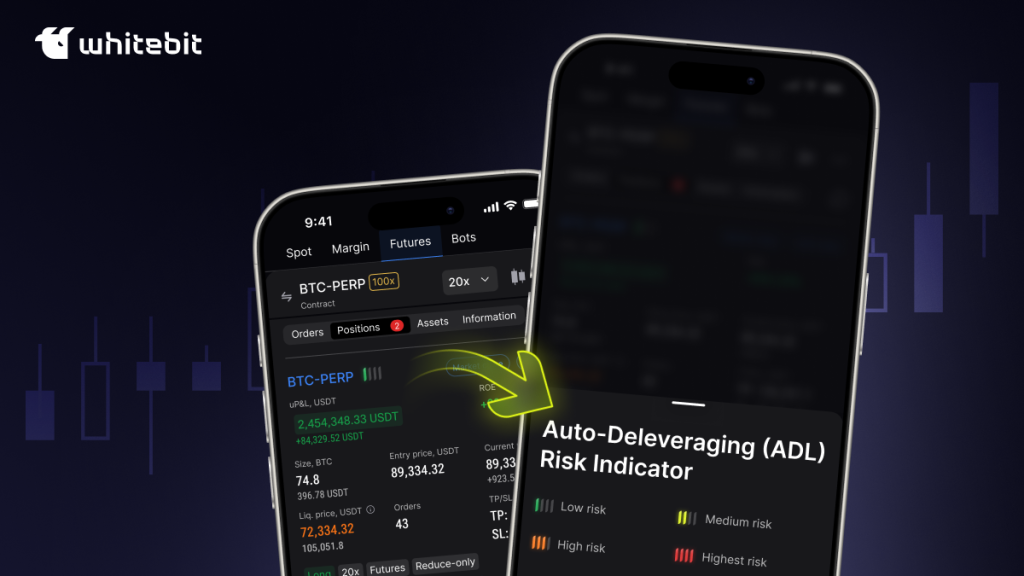
Every position on the market has a conditional “ranking” based on its profitability and leverage. This forms the ADL Grade.
The higher this grade, the higher the probability that the position may be used if ADL is triggered.
However, there’s an important nuance — even a high grade doesn’t guarantee it will definitely happen.
ADL always depends on a combination of factors: liquidation events, volatility, and temporary liquidity constraints. Under normal conditions, it simply isn’t used.
What happens if ADL is triggered
If your position is selected, it may be partially or fully closed.
This happens at a specially calculated price based on market conditions and the parameters of the liquidated position. So this is not random execution — the process is highly controlled.
When ADL is triggered, you will receive a push notification and an email.
Importantly, since only profitable positions are involved, you won’t incur losses due to ADL. It only affects the timing or price at which your profit is realized.
Why This Mechanism Matters
ADL does not influence your decisions. It doesn’t change your strategy or interfere with normal trading. But it becomes critically important when the market turns unstable.
That’s when it helps reduce extreme price distortions, ensures fairer execution, and supports the overall system.
In essence, ADL is part of the infrastructure you don’t notice while everything works smoothly. But without it, the market would look very different — more chaotic and less predictable.
Manage futures risk during volatility with ADL