Piercing Line Candlestick Pattern: A Complete Guide to Understanding and Trading It

There are many candlestick patterns in the world of technical analysis, but the Piercing Line deservedly occupies one of the central places among them. This reversal signal indicates with a high probability the beginning of an uptrend after a prolonged downtrend. Let’s take a closer look at what this pattern is and how it can be used for profitable trading.

List of cryptocurrencies by market capitalization
What Is Piercing Line Candlestick Pattern?
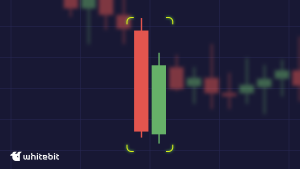
The Piercing Line is a bullish candlestick pattern that indicates a potential reversal of a downtrend, signaling the start of an uptrend. It consists of two candles:
- The first candle is a long bearish piercing pattern that closes below the previous day’s (or period’s) close.
- The second candle is bullish piercing pattern, opening below the close of the first candle, but closing at least halfway up the length of the bearish candle.
This pattern typically forms at the end of a downtrend and suggests that sellers are losing their grip while buyers are beginning to gain control of the market. The more the second candle engulfs the first, the stronger the reversal signal.
How to Identify the Candlestick Piercing Pattern on a Chart?
To accurately spot a Piercing candle pattern on a chart, it’s crucial to consider both the candlestick pattern and the broader market context — without the context, the signal loses its reliability. Here’s an algorithm to help identify the pattern:
- Identify a Downtrend: A Piercing Line forms only after a downtrend. If the market is in a flat or uptrend, it’s not a Piercing Line, but simply a candlestick combination.
- Look for a Strong Bearish Candle: The first candle of the pattern should be a prominent red candle with a body that reflects the dominance of sellers. The larger the body, the stronger the potential signal.
- Check for a Downward Gap or Impulsive Opening: The second candlestick (bullish) should open below the close of the first candlestick. In crypto markets, classic gaps are rare, so a sharp opening below or a quick downward push at the start of the candlestick is acceptable.
- Close Above the Middle of the First Candle: A key condition: the bullish candle must close above 50% of the body of the previous bearish candle, but not fully overlap it. If it overlaps entirely, the pattern becomes a Bullish Engulfing instead.
5. Evaluate the Position at Key Levels: The strongest Piercing Lines form:
- At support levels
- After a momentum drain
- In the oversold zone
- Near liquidity or range lows
6. Confirm the Signal: Ideally, the Piercing Line should be confirmed by:
- Increased volume on the second candle
- A reaction from the key level
- Divergence
- A confirming bullish candle following the pattern

How to Trade the Piercing Line Candle Pattern?
Piercing Line is traded as an early bullish reversal after a downtrend: entry is considered only after the close of the second candle and confirmation by the next candle or reaction from the support level.
The basic entry is long at the opening of the next candle or on a small pullback, with the stop loss placed below the pattern’s minimum. Targets are the nearest resistance zones or a fixed risk/profit ratio (1:2–1:3).
To filter out false signals, use:
- RSI (exit from oversold 30–35)
- Volume (growth on a bullish candle)
- EMA 20/50 (slowdown in the downtrend)
- MACD (weakening of the bearish momentum)
Trading Strategies Based on the Piercing Pattern
Let’s look at three basic strategies:
- Conservative strategy (with confirmation): Entry is made after the formation of the Piercing Line and the next bullish candle. The stop loss is placed below the pattern’s minimum, with the take profit at the nearest resistance level. This strategy is suitable for calm markets and higher timeframes.
- Strategy from the support level: The Piercing Line forms at a key level or demand zone. Entry is possible immediately after the pattern closes, with confirmation from volume and RSI. This strategy offers a good risk-to-reward ratio.
- Aggressive strategy (on impulse): Entry is made immediately after the close of the second Piercing Line candle, without waiting for confirmation. The stop loss is placed below the local minimum. This strategy is used only with strong momentum, divergence, or sharp volume growth.
Pros and Cons of Using the Candle Piercing Pattern
The advantages and disadvantages of Piercing Line include:
| Piercing Line Pros | Piercing Line Cons |
| Early signal of a possible reversal | High percentage of false signals without confirmation |
| Easy visual identification on the chart | Only works in a downtrend |
| Good at showing a change in market control | Weak signal in flat and low volatility |
| Clear levels for stop loss | Requires confirmation by indicators |
| Suitable for crypto, forex, and stock markets | Often gives pullbacks rather than full reversals |

Comparison Piercing Line Pattern with Other Reversal Patterns
Piercing pattern candlestick is weaker than Bullish Engulfing and Morning Star: it only shows a weakening of seller pressure, not their complete capitulation. Unlike Bullish Engulfing, where the second candle completely overlaps the first, the piercing line closes only above the middle of the bearish candle.
Compared to the Morning Star, which consists of three candles and gives a more reliable reversal signal, the Piercing Line triggers earlier but more often requires confirmation.
In terms of reliability, the Piercing Line outperforms single patterns such as the Hammer, as it is formed from two candles and better reflects the shift in the balance of forces. However, the hammer often works at key levels and extremes, while the breakout line is more effective after a sharp decline and in the deceleration phase of a downward movement.
Trade cryptocurrency on WhiteBIT
Conclusion
In technical analysis, the breakout line occupies an intermediate position between single candles and strong reversal patterns. It is a tool for assessing market intentions, not a ready-made solution for entry without additional analysis.