What Is a Project Roadmap?

How can you determine whether a cryptocurrency project is genuinely moving in the right direction? One of the most reliable signals is its roadmap. This development blueprint outlines the project’s core objectives and offers a transparent way to track progress across key milestones. In this article, we examine what a roadmap is, why it plays a crucial role in a project’s long-term execution, and how users and investors can use it to assess the prospects and real progress of emerging cryptocurrency initiatives.

Real-time cryptocurrency rates
What Is a Crypto Project Roadmap?
A crypto roadmap is a strategic document that outlines the planned development path and major milestones of a cryptocurrency project. It acts as a reference point for the team, investors, and users, clarifying which tasks must be completed, which technologies are expected to be integrated, and how the project intends to evolve over time. A well-structured roadmap sets clear objectives, defines expected timelines, and establishes a coherent plan of action, enabling a more transparent, predictable, and organized execution process.

Cryptocurrency Roadmap Structure
Roadmap for cryptocurrency typically includes several core elements that bring clarity and structure to the development process. Below are the key components usually found in a well-designed roadmap crypto:
- General Project Goals: A concise overview of the project’s mission and vision, along with its primary objectives and the problems it aims to address. This section explains why the project was created and what value it intends to deliver.
- Milestones: Short-, medium-, and long-term targets that outline the project’s progression. Examples may include launching an alpha release, introducing major features, expanding the user base, securing new partnerships, scaling infrastructure, entering new markets, or rolling out additional products.
- Key Stages: A breakdown of essential checkpoints required at each phase of development. These can include product launches, partnership agreements, or the integration of new technologies.
- Technical Developments and Updates: A detailed list of upcoming upgrades and technical implementations scheduled throughout the project’s lifecycle—for example, security enhancements, feature rollouts, or network-scaling improvements.
- Marketing Strategy: An outline of planned marketing and PR activities aimed at attracting users and investors. This may cover advertising campaigns, social media promotion, community initiatives, or participation in industry events and conferences.
- Timeline: A visual representation of the major stages and their expected completion dates. This can be presented as a chart, table, or graph indicating when key deliverables should be finalized.
- Expected Results: A clear description of what the project aims to achieve at each stage—such as user growth, increased liquidity, expanded market presence, improved network performance, or reaching defined security benchmarks.
Crypto Roadmap Examples
Below are illustrative examples that show how a project’s strategic development can unfold across different phases.
Cardano
The Cardano roadmap is structured around several major development eras, each dedicated to a specific aspect of the network’s evolution: Byron, Shelley, Goguen, Basho, and Voltaire.
In the Byron era, the project established its foundational layer, including the initial blockchain launch and wallet infrastructure. Shelley introduced network decentralization through staking and delegation, enabling broader participation and strengthening security. The Goguen era brought smart contract functionality, allowing developers to create tokens and deploy decentralized applications (dapp). Basho focused on throughput and scalability improvements, optimizing network performance for higher workloads. Finally, Voltaire introduced governance features, including on-chain voting and a community treasury system.
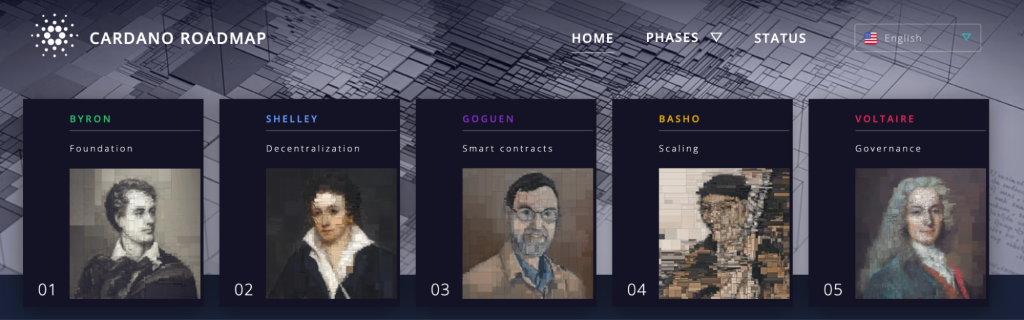
Cardano roadmap. Source: https://roadmap.cardano.org/en/
Polkadot
The Polkadot roadmap outlines a series of core focus areas and technological modules that highlight both ongoing work and future development priorities. Key components include advancing its multichain architecture through parachains and parathreads, enhancing cross-chain interoperability via the XCM protocol (including upgrades such as XCMv3 and XCMv5), enabling more dynamic resource allocation through the coretime model and Elastic Scaling, and expanding EVM compatibility alongside new tooling for developers.
Polkadot is also setting ambitious goals for governance improvements, moving toward a more decentralized and efficient decision-making framework. This includes scaling governance participation, lowering proposal thresholds, and refining processes through Governance V2 / OpenGov. Additionally, the team is developing a new core architecture—the Join-Accumulate Machine—designed to boost network flexibility, throughput, and overall performance. Together, these initiatives reflect Polkadot’s long-term vision for a more scalable, interoperable, and developer-friendly multichain ecosystem.
TON
TON’s roadmap for late 2025 centers on scaling the network, boosting performance, and building the infrastructure needed for mass adoption. One of its key achievements is the major core upgrade known as Accelerator, which significantly improved the network’s ability to handle high load, increased transaction throughput, and lowered hardware requirements for validators. In parallel, TON enhanced the toolkit available to node operators by introducing updated monitoring dashboards, alert systems, and recovery utilities — all of which contribute to a more stable and predictable validator experience.
At the same time, TON is rapidly expanding its payments stack. The project has launched a Layer 2 network designed to deliver ultra-fast, low-cost transactions for everyday users and trading platforms. The ecosystem layer is also advancing: developers now have access to improved API, the new TOLK smart contract language, and ongoing work on cross-chain interoperability and future sidechain infrastructure. Taken together, these efforts position TON as a scalable, adaptable ecosystem designed for real-world usage and long-term growth.
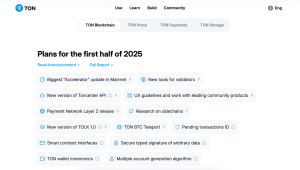
TON roadmap. Source: https://ton.org/en/roadmap
NEAR
The NEAR roadmap centers on two core priorities: strengthening the protocol itself and improving the overall user and developer experience. Within the Core track, the team continues to advance sharding and network scalability, focusing on optimizing transaction throughput, reducing latency, and refining the validation process. These improvements allow NEAR to handle more transactions with lower resource requirements, resulting in higher performance and greater network stability.
The Experience track is aimed at making the ecosystem more intuitive for both developers and end users. This includes building tools that streamline dApp development, enhancing UX flows, and simplifying account creation and interactions with the platform. The broader goal is to make NEAR more accessible and user-friendly, enabling easier onboarding, fostering the growth of decentralized applications, and strengthening NEAR’s position within the Web3 and DeFi ecosystems.
The Role of a Roadmap in Cryptocurrency Projects
Understanding a project’s roadmap — and the role it plays in shaping the ecosystem — is essential for evaluating the reliability and long-term prospects of any cryptocurrency initiative.
Transparency and Trust
A roadmap provides a clear view of how a project intends to evolve, allowing investors and users to track the concrete steps being taken toward its goals. By laying out a structured plan with defined milestones, the project builds credibility and demonstrates that its development is driven by strategy rather than improvisation. When a team consistently meets its stated deadlines and delivers on achievable objectives, it strengthens confidence in its ability to execute.
Predicting Project Success
When a project sets realistic yet forward-looking targets and executes them on time, it signals that the team is moving in the right direction. A roadmap helps investors and users understand which updates, features, and improvements are coming next, and how these changes may influence the broader ecosystem. This clarity enables market participants to better assess the project’s future potential and identify upcoming opportunities.
Impact on Token Price
Progress — or setbacks — relative to the roadmap can have a notable impact on a token’s market value. Successfully delivered milestones often boost investor sentiment, which can positively influence price dynamics. Conversely, delays, missed deadlines, or unfulfilled promises can undermine trust, create uncertainty, and put downward pressure on the token. In this sense, a roadmap is not only a development tool but also an important signal for market perception and valuation.
How to Analyze a Project’s Roadmap?
The following points will help you conduct a structured project analysis of any crypto project’s roadmap and assess its overall credibility:
- Assess the Realism of the Goals. Examine whether the stated milestones align with the project’s actual capabilities. Overly ambitious deadlines without sufficient resources, talent, or technical groundwork are a red flag. Strong projects typically set achievable targets and support them with clear technical explanations.
- Check Past Performance. If the project has been active for more than a year, review previous roadmaps to see whether the team actually delivered on earlier commitments. Teams with a consistent track record of meeting deadlines inspire far more confidence than those that frequently delay or abandon key milestones.
- Study the Technical Substance of the Milestones. Look beyond the timelines and analyze what the milestones actually entail. Significant developments — such as mainnet launches, smart contract implementation, or transitions to new consensus algorithm — signal tangible progress. Vague statements like “ecosystem improvements” offer little insight into real advancements.
- Compare with Competitors. Evaluate how similar projects have approached the same challenges. This helps determine whether the roadmap’s goals are realistic, whether the approach is technically unique, and whether the project is staying aligned with broader market and industry trends.
- Pay Attention to Transparency. A credible roadmap should be publicly accessible, regularly updated, and accompanied by clear explanations for any changes in priorities or timelines. Roadmaps that remain unchanged for years or are adjusted without communication raise significant concerns.
- Assess the Impact on the Ecosystem and Token. Identify which milestones could materially influence token value or expand the utility of the network. Major product releases, core protocol upgrades, or the introduction of DeFi components and Layer-2 solutions often serve as catalysts for ecosystem growth and market interest.
How to Develop Your Roadmap?
To build a clear, practical, and credible roadmap for a crypto project, it’s essential to follow several key steps that form the core of any effective crypto roadmap template:
- Define the Long-Term Vision. Start by identifying the core problem your product solves, the value it creates, and where you expect the project to be in 1–3 years. A well-defined vision sets the strategic direction for all future development phases.
- List All Key Tasks and Features. Outline the fundamental components that need to be delivered: network or app launch, integrations, smart contracts, tokenomics design, mobile solutions, marketing phases, and partnerships. At this stage, prioritize gathering ideas rather than assigning timelines.
- Break Tasks Into Stages. Group the tasks into clear time horizons:
- Short-term: 0–3 months
- Medium-term: 3–12 months
- Long-term: 12+ months
- Set Realistic Deadlines. Evaluate the workload, technical complexity, and available resources. Conservative, well-reasoned deadlines are far more credible than optimistic ones that lead to constant delays.
- Detail the Technical Requirements. For each stage, specify the exact work to be completed: technologies to be used, components to be deployed, and team responsibilities. This improves clarity and boosts transparency for both investors and internal stakeholders.
- Define Success Criteria. Attach measurable outcomes to every stage — examples include testnet launch, smart contract audit, MVP release, or user-base growth. Clear KPIs make the roadmap concrete and verifiable.
- Consider Risks and Alternatives. A robust roadmap anticipates potential delays, technical challenges, or external factors. Explain what might affect timelines or priorities and how the team will address such scenarios.
- Ensure Accessibility and Regular Updates. Make the roadmap publicly available to your community, investors, and partners. Update it as progress is made — consistent transparency is crucial for maintaining trust and demonstrating responsible project management.
Trade cryptocurrency on WhiteBIT
Conclusion
A roadmap is the foundation on which the development of any cryptocurrency project is built. It gives the team a structured path forward, helps investors understand the project’s long-term outlook, and provides the community with clarity on where the ecosystem is heading. A clear, well-designed roadmap makes the project more transparent, predictable, and resilient — ultimately increasing its chances of sustained, long-term success.