Retrodrop Crypto Definition: What It Is and How It Works

Imagine this: six months ago, you made a swap on a decentralized exchange, and now, out of the blue, the project credits you with tokens worth a whopping $1,500. Tempting, right? Especially if you believed that your only way to profit was through active trading. But how do you discover these projects? How can you secure such rewards? And most importantly, how do you steer clear of scam? In this article, we’ll dive into these questions and more.

Buy tokens before they hit the market
What is a Retrodrop?
A retrodrop is a reward mechanism designed to recognize users for their early involvement and contributions to a project. The term “retrodrop” is derived from the word “retro,” meaning “looking back,” and it reflects the concept of rewarding users for participating in a project during its initial stages of development.
Participation can take various forms, such as engaging with the project’s products, testing both main and test networks, translating materials, engaging on social media, voting, providing feedback, or supporting the project in forums and communities.
Predicting retrodrop crypto token distributions is nearly impossible, as projects typically don’t announce them in advance. There’s usually a set period where users have the chance to engage with the project, and those who are most active in the project’s ecosystem are often rewarded. However, there are exceptions. It’s important to note that retrodrop criteria can be highly unpredictable — sometimes, users might receive more for free activities than they would for paid actions like trading on the mainnet, buying NFTs, or running nodes. Ultimately, users are rewarded with native project tokens.
Why Were Retrodrops Created?
In the early days, a popular method of attracting investment was the ICO (Initial Coin Offering). Projects would offer the opportunity to purchase tokens before they were listed on exchanges, with developers promising to use the funds raised to create a product that would ensure the tokens’ value. However, in some cases, these promises remained just words. Numerous scam projects, a lack of guarantees for investors, and unequal access for large and small participants made ICOs less attractive. Furthermore, increased regulatory control and the possibility of tokens being classified as securities led to legal risks. At best, this slowed down the project’s development; at worst, it threatened its destruction. These factors undermined confidence in ICOs and prompted the search for fairer and safer financing and reward mechanisms. But how could a system be created that benefits both users and developers without breaking the law?
Retrodrops in crypto provide a unique solution to several problems. They not only encourage active testing and promotion of the product by users, but also help create a loyal community around the project. Participants, investing their time and effort, form a supportive ecosystem. The distribution of tokens, and sometimes even rumors about it, attract crypto enthusiasts from all over the world. This creates a healthy environment where users are motivated to support and develop the project, and developers receive valuable feedback and a growing base of supporters. Retrodrops also contribute to a more even distribution of tokens among participants, reducing the risk of centralization.
What’s the Difference Between a Retrodrop and an Airdrop?
While Retrodrops and airdrops are often viewed as similar, there are key differences between the two.
An airdrop is a method of distributing tokens to users who complete specific tasks, most commonly related to promoting the project on social media (e.g., subscribing to channels, posting, liking). The terms of an airdrop, including the number and type of rewards, are usually announced in advance by the project. Airdrops typically target a large audience, and rewards are often small due to the wide participant pool and simple actions required.
In contrast, Retrodrops are intended to reward users who have supported and actively participated in the project from its early stages. Retrodrops aim to increase the loyalty and engagement of participants, setting them apart from the rest of the community. The rewards in Retrodrops tend to be significantly larger, given the smaller number of users and their unique contributions. The main distinction, however, is that developers do not announce Retrodrops, their conditions, or deadlines in advance. This approach allows creators to separate true supporters from so-called “abusers” or “sybils”—individuals who exploit the project for personal gain by creating multiple wallets to maximize token distribution. This practice is known as multi-accounting.
How Do Crypto Retrodrops Work?
Let’s explore the basic principles and mechanics of a Retrodrop.
Distribution Mechanism
First, the criteria for users who will receive rewards are defined. Developers then set a deadline to create a snapshot of the network’s status, capturing the wallet addresses of eligible participants. Following this, Sybil accounts are typically filtered out. Once this process is complete, an announcement is made, and participants are invited to claim their drop on the project platform.
Reward Criteria
The conditions for receiving a Retrodrop depend on the developers’ criteria. These may include actions such as deploying smart contracts, voting participation, purchasing domain names, creating or buying NFTs, making deposits to the network or platform, achieving a certain volume or number of transactions, interacting with applications, or making donations. Additionally, projects might consider factors like staking participation, liquidity provision, asset holding duration, testnet activity, social media engagement, project support, and governance participation through DAO.
Another important criterion is the uniqueness of the user, their wallet, and, in some cases, their IP address. The wallet must not be linked to other participating wallets, as this would lead to filtering out Sybil attacks.
Top Retrodrop Examples
Let’s look at the largest rewards in the history of cryptocurrencies.
Uniswap
September 2020 saw Uniswap distribute 400 UNI tokens (approximately $1,300 at the time of distribution) to everyone who had used Uniswap at least once before September 1. This Retrodrop from Uniswap became one of the largest in history. Since then, many other projects have followed suit, rewarding active users.
1inch
All wallets that interacted with 1inch before midnight (UTC) on December 24, 2020, received 1INCH tokens. While the exact amount of the reward was not disclosed, the minimum reward was 600 1INCH, which was approximately $1,000 at the time of distribution. The conditions for receiving the tokens were as follows: at least one transaction before September 15, or at least four transactions in total, with a combined transaction value of at least $20.
APTOS
In October 2022, the Aptos Foundation launched a retrodrop to reward testnet participants who actively engaged with the project before the mainnet launch. As part of this retrodrop, users who minted APTOS ZERO NFTs on the test network received 150 APT (approximately $1,200 at the time of distribution), while users who submitted an application for the Aptos Incentivized Testnet received 300 APT each.
In total, over 20 million APT tokens were distributed to more than 110,000 participants during the first Aptos airdrop.

NFT Aptos Zero
Simply put, to receive the drop, you needed to mint an image to your wallet and complete a form.
Arbitrum
In March 2023, Arbitrum announced a Retrodrop for active participants. The criteria for receiving the drop were as follows:
- Bridge to the Arbitrum network (use the bridge at least once to transfer assets to the Arbitrum network);
- Time of use on Arbitrum (2, 6, 9 months);
- Total number of transactions (4, 10, 25, 100);
- Total number of transactions on Arbitrum Nova (3, 5, 10);
- Deposit assets worth $10,000, $50,000, $250,000.
Meeting just one of these criteria was enough to receive a minimum reward of 625 ARB (approximately $800 at the time of distribution).
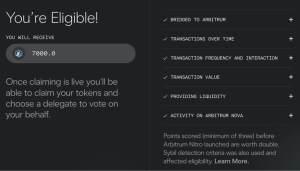
Screenshot of the page with the Arbitrum Retrodrop claim
Participants who met all the criteria could collect 7,000 ARB (approximately $9,800 at the time of distribution).

How Retrodrops Affect Crypto Communities and Why They Matter?
No one likes to work for nothing, and crypto enthusiasts are no different — they engage with projects where activity is recognized and loyalty is rewarded. This approach creates a sense of value and belonging, motivating users to continue participating and promoting the project both within and outside its community. It fosters deeper, more sustainable relationships between users and the project, which is the cornerstone of building a loyal community.
Moreover, Retrodrops attract individuals from various professions and backgrounds. Without them, the popularization of cryptocurrency would progress much more slowly. Imagine someone just beginning to explore the world of crypto. By performing simple activities and receiving a reward, they have a tangible entry point into the ecosystem, making cryptocurrency a development vector for years to come.
How to Analyze a Project for a Possible Drop?
Thanks to thorough DYOR (Do Your Own Research), you can save time and avoid unnecessary stress. What should you focus on before taking action?
- Study the project team. Analyze the team’s experience, see what they’ve worked on in the past, and check their reputation.
- Analyze the White Paper and Roadmap. This will help you understand the project’s value, goals, and development plans.
- Evaluate the tokenomics. Find out the total token supply and the percentage allocated to the community.
- Check the investments. Be sure to check which funds have invested in the project and how much they’ve put in. Experience shows that reputable large funds typically avoid investing in empty projects.
- Evaluate social networks. Look at X (formerly Twitter): how many followers does the project have, who follows them, and are the users active? Pay attention to Telegram and Discord channels. These should be lively, with real people engaging in meaningful discussions.
How to Get a Retrodrop?
First, you need to find a project with potential for a Retrodrop. Stay updated by following news on X (formerly Twitter) and Telegram channels. Many of these channels specialize in tracking projects with potential drops and publish relevant news.
Once you’ve identified a project, focus on the following activities:
- Testnets: Before launching the mainnet, a project tests its product’s reliability and security on a test network. This is a great opportunity to participate in testing stages and showcase your involvement. Participants in testnets often receive rewards when tokens are distributed.
- Quests: Platforms like Galxe host tasks posted by projects, often related to social media (liking, subscribing, retweeting, etc.). Completing these tasks can earn you roles (special statuses) in Discord. The more unique the role, the higher your chances of receiving more tokens when they are distributed.
- Interaction with the product: This includes using bridges, conducting regular transactions, providing liquidity, purchasing NFTs, and more.
- Ambassador programs: Writing or translating articles, creating and distributing content—anything that increases the project’s visibility boosts your chances of receiving a Retrodrop.
Advantages and Disadvantages of Retrodrops
When considering the pros and cons of Retrodrops, it’s important to examine them from both the project’s and the user’s perspective.
User Perspective
Pros of Retrodrops:
- Accessibility: Retrodrops don’t require deep knowledge of cryptocurrencies, making them accessible to a wide audience. Activities on the test network allow participation without using personal funds.
- Large rewards: Retrodrops can yield significant rewards, especially if the project becomes successful. This presents a great opportunity to earn a substantial deposit during a bear market and explore other areas of cryptocurrency.
Cons of Retrodrops:
- Uncertainty and risk: You can invest time and resources into participating in a project and still not receive any rewards.Technical difficulties: During high demand periods, test token faucets can be overloaded, and gas fees can spike, which slows down the execution of activities.
- Monotony: Repeating the same actions at set intervals can be tedious and boring. It can be psychologically challenging to stay fully engaged in this niche, especially when FOMO (fear of missing out) arises from missing a project that distributed rewards.
- Risk of scam: Scammers exploit drop announcements. When many people rush to claim rewards, official project websites can become overloaded and go down temporarily. In the midst of this, users may look for alternative ways to stake and sell tokens, which can lead them to scam websites. Connecting wallets to these fraudulent sites results in the loss of tokens. Scammers also use platforms like X and Discord to target potential victims.
Projects Perspective
Advantages of Retrodrops:
- Flexibility in distribution: Retrodrops offer a flexible token distribution process, reducing the potential for legal complications.
- Unique users: Distributing tokens helps quickly build a base of active users, which is crucial for launching a project and meeting decentralization and token-holder diversity requirements for exchange listings.
- Marketing: Retrodrops generate media coverage and attract new participants, helping the project stand out among competitors.
- Trading volume: Token distribution boosts trading volume, creating market momentum and drawing the attention of traders and investors.
Disadvantagesof Retrodrops:
- Multi-accounts: Projects must implement mechanisms to identify unique wallets and prevent multi-accounting.
- Exploits: Retrodrops are often distributed early in a project’s development, before the blockchain undergoes thorough testing or a security audit. The influx of users can reveal vulnerabilities that attackers may exploit for their benefit.
- Price drops: After distributing rewards, it can be difficult for projects to maintain the price of their cryptocurrency, as many recipients immediately sell their tokens. This increased supply in the market can lead to a temporary price drop.
The Future of Retrodrops
By the end of 2025, we may see projects adopting new approaches to user identification, while retro hunters develop new strategies to bypass filtering. Some still treat Retrodrops as a hobby, while others are seeking opportunities to retrain in crypto-related activities. One thing is certain: despite the changes, Retrodrops continue to draw newcomers into the world of cryptocurrencies.
Start your journey in the crypto world with WhiteBIT
Conclusions
In this article, we’ve discussed the retrodrop meaning, what retro drops are, how to participate in them, and how to analyze projects. Simply put, retro drops provide a unique opportunity for users to earn tokens. Despite the evolving mechanics, this process continues to capture the attention of crypto enthusiasts. It is a dynamically developing aspect of the cryptocurrency world, having a significant impact on both projects and users. Retro drops offer an excellent entry point for those interested in cryptocurrency but hesitant to try their hand at trading.