What Is a Crypto Card?
You can store crypto, trade on an exchange, or stake it—but can you pay for your coffee or a subscription with it? It is the task that the crypto cards solve. We will explore these cards, how they are connected to the exchanges, and how they differ from fiat cards below.

Get card for cryptocurrency
What Are Crypto Cards?
Crypto cards are payment instruments that enable cryptocurrency spending through established card networks such as Visa or Mastercard. Crypto cards are linked to exchange accounts or custodial crypto wallets and automatically convert digital assets into fiat at the point of sale. For the user, it feels like a regular card payment; for the merchant, it’s processed as a standard transaction through Visa or Mastercard. Positioned at the convergence of DeFi and traditional payment systems, crypto cards serve as a controlled bridge between on-chain assets and off-chain commerce.
What Is a Crypto Card Used for?
A crypto card enables the use of digital assets across a range of everyday financial scenarios, including:
- Everyday purchases: groceries, dining, and retail payments, both online and in physical stores;
- Online payments: subscriptions, travel bookings, and software or platform services that rely on card payments;
- Travel spending: automatic currency conversion at the point of sale, eliminating the need for manual FX exchange;
- ATM withdrawals: converting crypto into local fiat for cash access when required
- Crypto rewards and cashback: earning cryptocurrency-based incentives on regular spending, subject to the card program;
- Reduced reliance on banks: using crypto for daily payments without depending on a traditional bank account.
Collectively, these use cases position crypto cards as a practical interface between digital assets and real-world purchasing power.
Types of Crypto Cards
Crypto cards can be classified into two main categories: exchange-based cards
and wallet-based cards. The first ones connect the exchange crypto balance to the card and offer a wider range of crypto services, while the second ones connect the wallet balance to the card with limited crypto functionality, such as withdrawals, deposits, and payments. See the crypto cards comparison categories below.
Crypto cards can be issued in virtual form for online payments, subscriptions, and app-based transactions, as well as in physical form (traditional plastic or metal cards) for in-store purchases and ATM withdrawals. Many also include reward mechanisms, such as cashback or cryptocurrency incentives, typically linked to spending volume or account tiers, making flexibility, accessibility, and multi-asset support the defining characteristics of modern crypto cards. In many jurisdictions, spending cryptocurrency may constitute a taxable event, and applicable taxes depend on local regulations.
How Do Crypto Cards Work?
At the point of purchase, the card issuer converts the selected cryptocurrency into fiat currencies at the prevailing market rate. Settlement occurs in local currency, with the corresponding value deducted from the user’s crypto balance. This conversion is executed instantly at checkout, removing the need for prior asset exchange.
Most crypto cards are linked to custodial wallets or exchange accounts. Depending on card configuration, users can select which asset to spend—such as Bitcoin, Ether, stablecoins, or fiat. Because transactions are routed through networks like Visa or Mastercard, the card is accepted wherever those networks operate.
Operationally, crypto cards function as debit cards rather than credit instruments. They do not provide a borrowing facility; spending is limited to available balances. The only real difference is the source of funds—crypto is converted into fiat when you pay.
Crypto Card Review: Benefits and Limitations
This table outlines the practical advantages of crypto cards alongside their structural and regulatory constraints.
| Crypto Card Benefits | Crypto Card Limitations |
| Enables everyday spending of crypto without manual conversion | Conversion to fiat at payment may trigger taxable events |
| Accepted globally via Visa or Mastercard networks | Availability varies by country and region |
| Provides immediate access to crypto liquidity | Exchange rates and conversion fees may apply |
| Removes the need for merchants to support crypto directly | Limited control over execution price during conversion |
| Often includes crypto-denominated cashback or rewards | Rewards may depend on staking or asset holdings |
| Supports multiple cryptocurrencies and fiat currencies | Asset availability differs by provider |
| Familiar payment experience aligned with traditional cards | Requires reliance on a custodial issuer |
| Great for travel and paying abroad | ATM withdrawals may incur additional fees |
What Is WhiteBIT Nova?
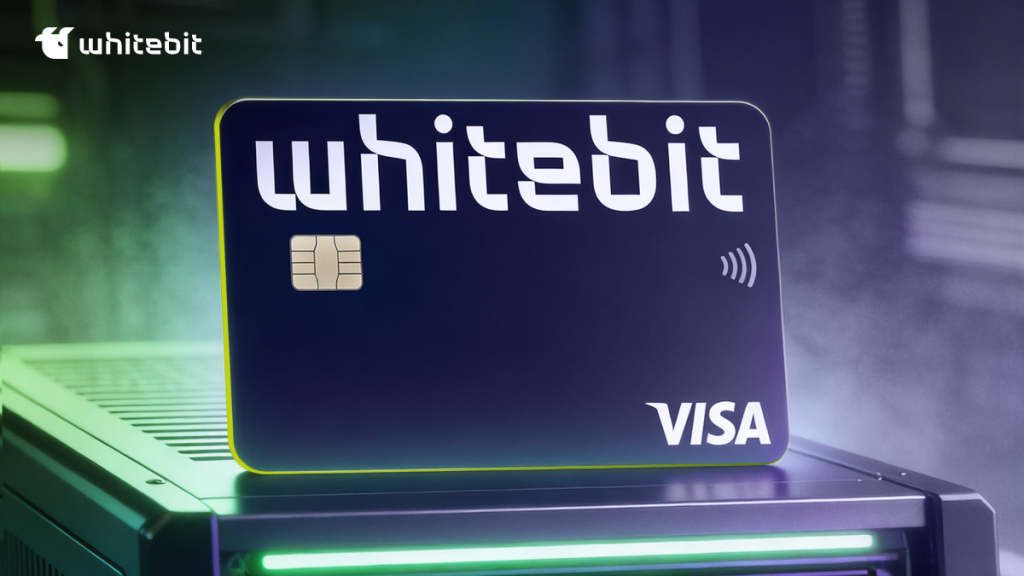
WhiteBIT Nova is a branded Visa crypto debit card from the WhiteBIT ecosystem, integrated with the user’s account on a centralized exchange and the platform’s mobile app. It is issued within the European payment infrastructure and operates in accordance with KYC/anti-money laundering requirements, ensuring legal and transparent use in everyday transactions.
The card, limits, security settings, and access are managed directly through the WhiteBIT interface, making Nova part of a unified financial environment rather than a separate external product. The card is accepted anywhere the Visa network operates, both online and offline, including international retail chains and services.
Benefits of Using the WhiteBIT Card
Key features of WhiteBIT Nova include:
- Multi-asset support: compatible with a broad range of digital assets, including USDC, BTC, ETH, XRP, SOL, NEAR, ADA, AVAX, WBT, DOGE, EURI, and EURR
- Global acceptance: usable for everyday purchases anywhere Visa is accepted, excluding restricted jurisdictions
- Crypto cashback rewards: earn up to 10% in cryptocurrency like WhiteBIT coin or Bitcoin, credited automatically on eligible spending
- Flexible card formats: available as both virtual and physical cards, with support for Apple Pay and Google Pay
How to Order a Crypto Card?
Follow these steps to get a crypto card from WhiteBIT:
- Log in to your WhiteBIT account: Access your account via the web platform or the WhiteBIT mobile app.
- Enter the card section: Navigate to Products / U Finance, select WhiteBIT Nova, and click “Get Your Card”.

- Accept the terms: Review and agree to the Terms and Conditions to proceed with the application.
- Choose your card type: Select either a virtual or physical card. Virtual cards are issued free of charge.
- Complete identity verification, if required: If the card is not immediately available in your country, you may be asked to provide proof of address from an eligible jurisdiction.
- Set security details: For physical cards, create a PIN and confirm your phone number via SMS. Virtual cards do not require a PIN.
- Provide delivery details for a physical card: Enter your full address, confirm delivery information, and complete any applicable shipping payment.
- Receive confirmation: Once submitted, you’ll receive a confirmation message. Virtual cards are issued instantly, while how long it takes for the crypto card to arrive depends on the chosen delivery method.
Until activation is completed, the card remains inactive, and its functions are unavailable. After activation, you can use a crypto card with Google Pay or Apple Pay for NFC payments.
How to Use a Crypto Card?
Activate the crypto card in the app by opening Card Settings and tapping Unfreeze. To complete activation, insert the card into a terminal and enter your PIN, or perform any ATM transaction. This step enables contactless payments.
The WhiteBIT card is built around flexibility and control, making everyday crypto spending simple and intuitive. Before using the card, it’s enough to have funds available on the exchange, after which spending priorities, expense limits, and preferred cashback categories can be configured directly in the app. Users can also customize the card design, adding a personal touch to the experience.
You can also add a crypto card to Apple Wallet or Google Pay to make contactless payments with your phone or wearable device, while a physical card remains available for in-store purchases and ATM withdrawals. Even without a physical card, all card details needed for online payments can be accessed instantly in the app by tapping on the card.
It’s important to note that the WhiteBIT Nova card does not support incoming transfers from other bank cards—funds must be held directly on the exchange to be used for payments. The card can be managed directly in the app and instantly frozen or deactivated if lost or stolen.
Open WhiteBIT Nova now!
Conclusion
Crypto cards convert digital assets from passive holdings into functional payment instruments, closing the gap between ownership and everyday use. By combining familiar card-based payments with instant access to crypto liquidity and global acceptance, they integrate cryptocurrencies into modern spending workflows. For users seeking utility beyond trading or long-term storage, crypto cards offer a direct and efficient way to embed digital assets into daily financial activity.
FAQ
A crypto card can be an effective instrument for users who want to move digital assets from storage into everyday spending. It enables direct payment with cryptocurrencies such as Bitcoin or Ethereum, typically combined with features like cashback, reward programs, and automatic fiat conversion at the point of sale. Its practical value depends on individual spending patterns, the crypto card fees structure, and the incentives offered by the issuer. For users who actively engage with crypto, a card provides a streamlined way to spend globally without manual currency conversion.
No, there are no true crypto credit cards in the strict financial sense. What exists instead are reward-based cards offered by certain crypto platforms that resemble credit cards in their billing and spending experience but do not extend actual credit. Users do not borrow cryptocurrency. Access to higher reward tiers typically requires holding or staking assets with the issuer. Transactions are settled in fiat (or crypto converted to fiat instantly), while rewards are paid in cryptocurrency.
Yes—crypto debit cards are widely available. Unlike credit cards, they are funded directly from a user’s crypto balance and do not involve borrowing. They allow purchases and cash withdrawals through standard card infrastructure, with cryptocurrency converted into local fiat at the point of transaction. This eliminates the need for manual conversion while preserving the familiar debit card experience. WhiteBIT Nova is one such example.
To apply for a crypto card, users must select a provider that offers card-issuing services, such as WhiteBIT. The process typically involves creating an account and completing KYC verification. Once approved, a virtual or physical card can be ordered and used for transactions immediately upon issuing.
A crypto Visa card can be used anywhere Visa is accepted, across millions of merchants worldwide. This includes online and in-store purchases, ATM cash withdrawals, and any service that supports Visa payments. At the point of transaction, cryptocurrency is automatically converted into local fiat currency, enabling digital assets to be used seamlessly for everyday spending on a global scale.