Who Created Bitcoin? Who Is Satoshi Nakamoto?

The mystery behind the name Satoshi Nakamoto continues to be one of the most discussed topics in the cryptocurrency world. Who is behind this pseudonym — a lone programmer, a group of enthusiasts, or perhaps an entire organization? Let’s try to figure it out.

Bitcoin price on the WhiteBIT cryptocurrency exchange
When Did Bitcoin Start and Why?
Bitcoin emerged in the wake of the 2008 global financial crisis, a time when trust in traditional financial systems had been severely undermined. On October 31, 2008, the white paper titled Bitcoin: A Peer-to-Peer Electronic Cash System was published, and on January 3, 2009, the first block of the Bitcoin network, known as the genesis block, was mined — marking the official birth of Bitcoin. Within the genesis block, in the coinbase data section (typically used to embed messages during block mining), Satoshi Nakamoto left a poignant message:
“The Times 03/Jan/2009 Chancellor on brink of second bailout for banks.”
This message, referencing a headline from The Times, highlighted the dependency of banks on government bailouts and underscored the core philosophy behind Bitcoin: independence from both banks and the state.
Bitcoin introduced a novel model where the creation, transfer, and accounting of value are governed not by regulatory decisions, but by pre-established rules and cryptography. Through the use of Proof-of-Work, a distributed network of nodes, and digital signatures, Bitcoin eliminated the need for intermediaries, establishing a fixed supply cap of 21 million coins. The outcome is a system with predictable properties, resistance to censorship, and a transparent economy where trust is embedded in code, setting Bitcoin apart from all previous forms of money, including fiat currencies.

What Is Known About the Creator of Bitcoin?
Surprisingly, little is known about the Bitcoin creator — and this is no accident, but a deliberate choice. Operating under the pseudonym Satoshi Nakamoto, this individual (or group) first entered the public sphere in 2008, publishing the Bitcoin white paper and engaging in discussions on cryptographic forums and mailing lists.
Satoshi communicated in impeccable technical English, displaying a profound understanding of cryptography, distributed systems, and economics, yet never revealed any personal details. Between 2010 and 2011, Satoshi gradually scaled back his involvement, transferring control of the code repository and keys to other developers. On December 12, 2010, he completely vanished from the public eye, and since then, no verifiable communication has emerged from him.

Satoshi Nakamoto’s last post on the Bitcointalk forum. Source: https://bitcointalk.org/index.php?topic=2228
Over the years, numerous theories about his identity have surfaced, ranging from individual cryptographers and programmers to the possibility of a team of developers, but none have been definitively proven. More crucially, Satoshi’s disappearance played a pivotal role in Bitcoin’s decentralization, further cementing its status as an autonomous, trustless system.

Why Is Satoshi Nakamoto Keeping Their Identity Anonymous?
Satoshi Nakamoto’s decision to remain anonymous is not coincidental but a deliberate choice, driven by both technical and philosophical considerations:
- Decentralization and the Philosophy of Bitcoin: A core principle behind Bitcoin is decentralization. Satoshi likely intended to create a system that would not rely on any single individual or group. Revealing his identity could have resulted in the formation of a personality cult or a concentration of influence, which would contradict the very essence of Bitcoin — a decentralized network where all participants are equal, and the system is governed by code and consensus.
- Protection from Interference and Pressure: Creating a revolutionary financial system like Bitcoin could have serious legal and political implications. Satoshi Nakamoto was likely aware of the potential risks, including lawsuits, government pressure, or security threats. By maintaining his anonymity, he (or they) shielded themselves from possible consequences, ensuring that the focus remained on the project rather than its creator.
- Staying Focused on the Technology: Satoshi may have also wanted the attention to remain on the project itself — the technology that has the potential to transform the world — rather than on his personal identity. Any focus on him could have diverted attention away from Bitcoin’s underlying ideas, their implementation, and its ongoing development.
- Pragmatism and a Long-Term Perspective: There’s also a pragmatic element to Satoshi’s anonymity. The project he created has become so impactful that the identity of its creator is largely irrelevant to the network’s future. By removing himself from the spotlight, Satoshi reinforced the principle that Bitcoin can thrive and evolve without the involvement of its creator, demonstrating that even its originator is not essential to the system’s existence or growth.

Who Invented Bitcoin: Probable Satoshi
There are several theories regarding the identity of Bitcoin’s creator. Although the true identity of Satoshi Nakamoto remains elusive, some of the most likely candidates for the role include the following individuals.
Hal Finney
Hal Finney was a renowned computer cryptographer and one of Bitcoin’s earliest contributors. He was the recipient of the first Bitcoin transaction, when Satoshi Nakamoto sent him 10 BTC in January 2009, marking the first use of the network.
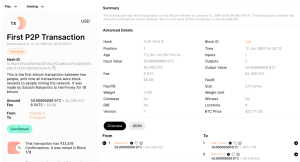
The first Bitcoin transaction between two users. Source: https://www.blockchain.com/
Additionally, Finney played a pivotal role in the development of Reusable Proof-of-Work (RPOW), a system that preceded Bitcoin and utilized the same Proof-of-Work principle to prevent internet spam. This system served as a key inspiration for Bitcoin, particularly in terms of implementing cryptographic proofs and distributing computing resources. Finney was also one of the first to run the Bitcoin client on his computer, positioning him as a significant early participant in the network. His technical expertise and early involvement with Bitcoin solidified his reputation as one of the leading candidates for the role of Satoshi Nakamoto.

Hal Finney’s tweet about running the Bitcoin client. Source:https://x.com/halfin/status/1110302988
This tweet was posted on January 11, 2009, just days after Satoshi Nakamoto mined the genesis block and shortly before Finney received his first Bitcoin transaction from Nakamoto.
Nick Szabo
Nick Szabo is an American cryptographer and digital currency theorist, best known for creating the Bit Gold concept — a system that shares significant ideological and architectural similarities with Bitcoin. Linguists have compared his writing style and ideas to those of Satoshi Nakamoto, but there is no definitive proof linking him to the pseudonym. Szabo himself has denied being Nakamoto.
Adam Back
Adam Back, the inventor of Hashcash — a Proof-of-Work consensus mechanism that was later adopted by Bitcoin — is another candidate in the search for Nakamoto’s identity. His name is even mentioned in the Bitcoin white paper, and experts acknowledge the substantial influence of his work on Bitcoin’s architecture. Despite this, Back has also denied being the creator of Bitcoin.
Len Sassaman
Len Sassaman, a cryptographer and member of the cypherpunk movement, has been suggested as a possible candidate in some discussions. Although his name is now mentioned less frequently, his technical expertise and involvement in the cryptographic community have kept his name in the conversation. Sassaman passed away in 2011, and his potential role as Nakamoto remains speculative.
Craig Steven Wright
Craig Steven Wright, an Australian entrepreneur and scientist, has publicly claimed to be the bitcoin inventor. However, his assertions have been widely criticized within the cryptocurrency community. A British court has ruled that he is not Nakamoto, further discrediting his claims.
Peter Todd
Peter Todd, a Canadian developer and cryptographer, was suggested as a possible Satoshi Nakamoto in a 2024 HBO documentary. Todd has firmly denied these claims, and most experts consider this theory unlikely.

Satoshi Nakamoto Net Worth
Many people ask how many bitcoins does Satoshi have. Nakamoto mined approximately 1 million BTC in the early years of the network’s existence — a vast fortune that remains untouched and has never been moved, further fueling the mystery surrounding his identity. It is important to note that Satoshi had several crypto wallets associated with this significant amount of Bitcoin, all of which have remained inactive since their creation. This serves to highlight his commitment to anonymity and decentralization, as he never personally benefited from owning such a large amount of cryptocurrency.

Net worth of satoshi nakamoto. Total amount of Bitcoin in Satoshi Nakamoto wallets. Source:https://intel.arkm.com/explorer/entity/satoshi-nakamoto
How Can the Bitcoin Founder Affect the Value of Bitcoin
The movement or sale of Satoshi Nakamoto’s Bitcoins could trigger significant volatility in the market and create a psychological shock among investors. Given that these coins have remained untouched for so long, their movement could be seen as a signal of instability, potentially leading to a panic sell-off. Sellers may fear an influx of supply, which could substantially lower the price of BTC. Many traders might interpret such actions as “unnatural,” potentially undermining confidence in the decentralization of the network.
From an economic standpoint, while the cryptocurrency market is now mature enough to handle such a shock without catastrophic consequences, experts point out that liquidity and volatility in the short term would likely be significant. However, if these coins were moved gradually, the market could adapt, and the price of BTC would likely stabilize over time. Notably, the movement of these coins would not only impact the economy but also challenge the philosophical foundation of Bitcoin, reinforcing confidence in the notion of a decentralized financial instrument that operates independently of any individual participant.
Buy Bitcoin on the WhiteBIT cryptocurrency exchange
Conclusion
One way or another, the mystery of Satoshi Nakamoto remains one of the most intriguing aspects not only of Bitcoin’s history, but of the entire cryptocurrency industry. Regardless of whether he was a real person or a group of developers, his legacy lives on in every transaction, every block, and every step that brings the world closer to decentralization.